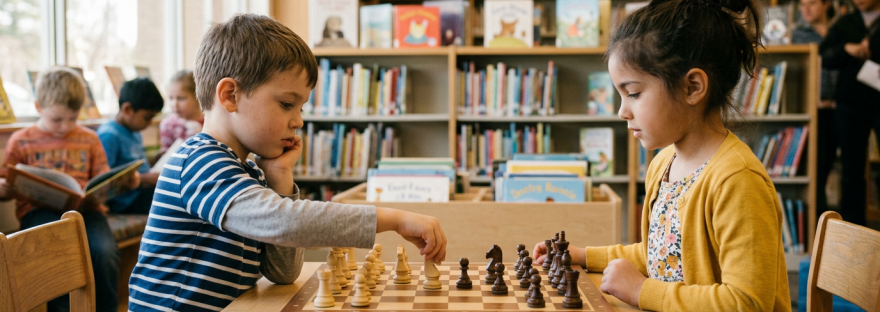
Chess is often described as a game of strategy, but for children it can be much more than a competition between two players. It is a playful way to develop thinking skills, emotional maturity, independence, and social confidence. Every game presents a new problem: a child must observe the position, consider several possibilities, predict consequences, and choose a response. At the same time, children learn to manage excitement, disappointment, pressure, and uncertainty.
The benefits of chess do not depend on becoming a tournament champion. A child can gain valuable experience simply by learning the rules, solving puzzles, playing casually with family members, or participating in a school chess club. When taught in an encouraging and age-appropriate way, chess provides a structured environment in which children can think deeply, make decisions, learn from mistakes, and enjoy meaningful interaction with others.
Developing Critical Thinking and Problem-Solving Skills
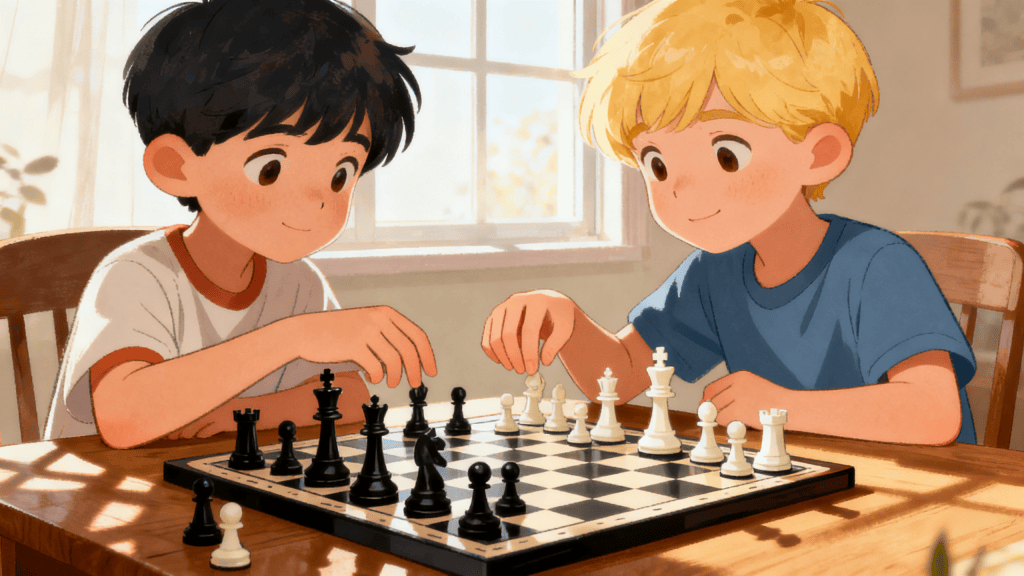
One of the clearest benefits of chess is that it encourages critical thinking. Children cannot play successfully by moving pieces randomly. Before making a move, they must examine the position, identify possible threats, and decide which option is most sensible.
For example, a child may notice that an opponent’s piece is attacking the queen. The child must then determine whether to move the queen, protect it, create a counterattack, or accept a different risk. This process involves analyzing information, comparing alternatives, and evaluating likely outcomes.
Chess also teaches children to adapt knowledge rather than merely repeat it. Beginners often learn familiar patterns, such as basic checkmates, opening principles, or tactical ideas. Memorizing these patterns is useful, but memorization alone is not enough. A position on the board may resemble a familiar example while containing important differences. Children must ask whether the same idea still works and, if not, how it should be modified.
This combination of memory and adaptation is a foundation of practical critical thinking. Children learn that knowledge is most useful when they understand how to apply it in changing circumstances. These habits can support problem-solving in other areas, including schoolwork, everyday decisions, and creative projects.
Strengthening Memory, Concentration, and Attention
Chess requires children to remember rules, piece movements, strategic principles, tactical patterns, and common positions. As they gain experience, they may also remember opening sequences, checkmate patterns, and mistakes from previous games. This repeated practice can strengthen their ability to recognize and organize information.
Concentration is equally important. A player must pay attention not only to personal plans but also to the opponent’s threats. A child who becomes distracted may overlook a simple capture or check. As a result, chess encourages children to maintain attention over an extended period and to return their focus to the position after each move.
Long games can also develop mental stamina. Children gradually learn that worthwhile results may require patience. They may need to examine several possibilities before finding a good move, or wait through a difficult position before an opportunity appears. This experience can help them understand that focused effort is sometimes gradual rather than immediately rewarding.
Chess should not be presented as a guaranteed solution for attention difficulties or as a substitute for professional support. However, its structure naturally gives children repeated opportunities to practice sustained attention, careful observation, and self-control. For some children, particularly those who enjoy strategy and puzzles, this makes concentration more engaging than exercises presented in isolation.
Learning to Plan and Make Decisions
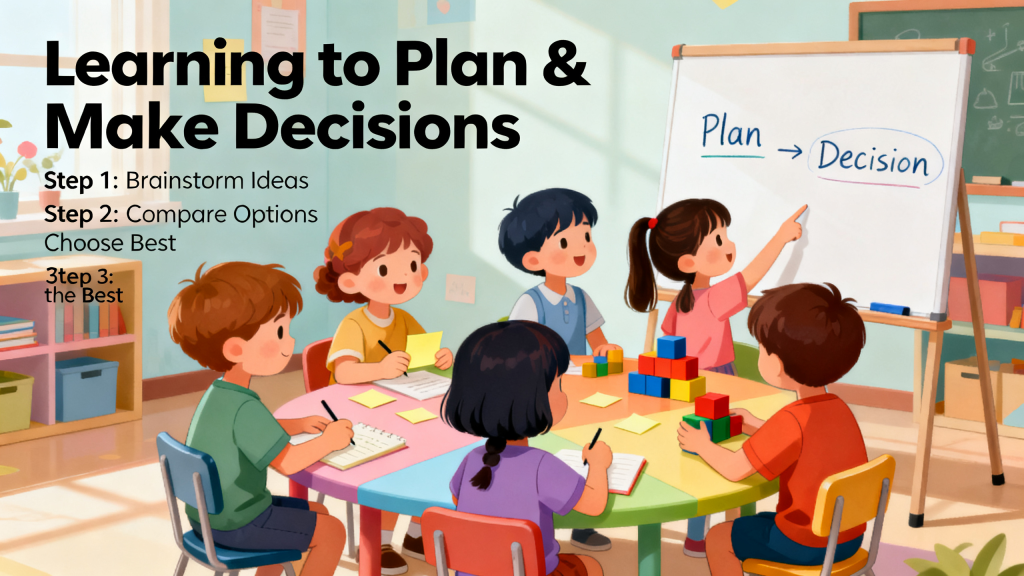
Every chess move is a decision with potential advantages and disadvantages. A child may have to choose between capturing material, developing a piece, defending the king, or preparing a longer-term plan. The strongest-looking move is not always the best one, and this teaches children to look beyond immediate rewards.
Chess also introduces the idea of thinking ahead. Players ask questions such as:
- What does my opponent want to do?
- What will happen after I make this move?
- Which of my pieces may become vulnerable?
- Is the potential reward worth the risk?
- Do I have a plan if my first idea fails?
At first, young players may consider only one move at a time. With practice, they begin to calculate short sequences and anticipate possible responses. They also learn to distinguish between a plan and a guess. A plan is supported by observation and tested against the opponent’s likely reply.
Because chess is largely an individual activity, children experience a direct connection between decisions and outcomes. A careless move may lead to the loss of a piece, while a thoughtful decision may create an advantage. This does not mean children should be blamed harshly for mistakes. Rather, the game gives them a manageable setting in which to develop responsibility and learn that decisions have consequences.
Supporting Academic Development
Chess uses many skills that are also valuable in academic learning. Players interpret symbols, recognize patterns, compare alternatives, follow rules, and solve problems logically. The board also develops spatial reasoning: children must understand lines, distances, directions, relationships between pieces, and how a position may change after several moves.
These abilities are relevant to mathematics, particularly when children work with patterns, sequences, logical relationships, and planning. Chess can also support independent learning because children often review games, identify errors, study unfamiliar positions, and test possible solutions on their own.
Some studies have reported positive relationships between chess instruction and performance in areas such as mathematics and reading. However, these findings should be interpreted carefully. Chess does not automatically make every child achieve higher grades, and academic outcomes depend on many factors, including teaching quality, home environment, motivation, and the broader educational setting. Children who participate in chess may also differ from non-players in ways that influence achievement.
The most reasonable conclusion is that chess offers useful practice in transferable mental processes. When combined with good teaching and regular academic support, it may reinforce habits such as careful analysis, persistence, and independent problem-solving. It should complement, not replace, reading, mathematics, physical activity, creative work, and other important parts of childhood.
Building Emotional Resilience
Chess provides frequent opportunities to experience mistakes and setbacks. A child may overlook a threat, lose an important piece, or miss a chance to win. These moments can be frustrating, especially when the child has invested effort in the game. Yet this is also where chess can teach resilience.
After a game, children can examine what happened. Was the problem caused by moving too quickly? Did the child fail to notice an attack? Was the original plan unrealistic? By identifying a specific mistake, the child can turn disappointment into a practical lesson.
This process helps children understand that losing is not a permanent judgment about their intelligence or ability. It is information about what happened in one situation. Improvement comes from reviewing the experience and trying again.
Chess also teaches delayed gratification. A child may need to wait before launching an attack, develop pieces patiently, or preserve a small advantage over many moves. The game rewards attention and preparation rather than constant impulsive action. Over time, children can become more comfortable with slowing down, tolerating uncertainty, and working toward a result that is not immediate.
Adults play an important role in this process. If parents and teachers treat every game as a test of ability, chess may create unnecessary anxiety. If they treat mistakes as part of learning, children are more likely to develop confidence and persistence.
Encouraging Sportsmanship and Character
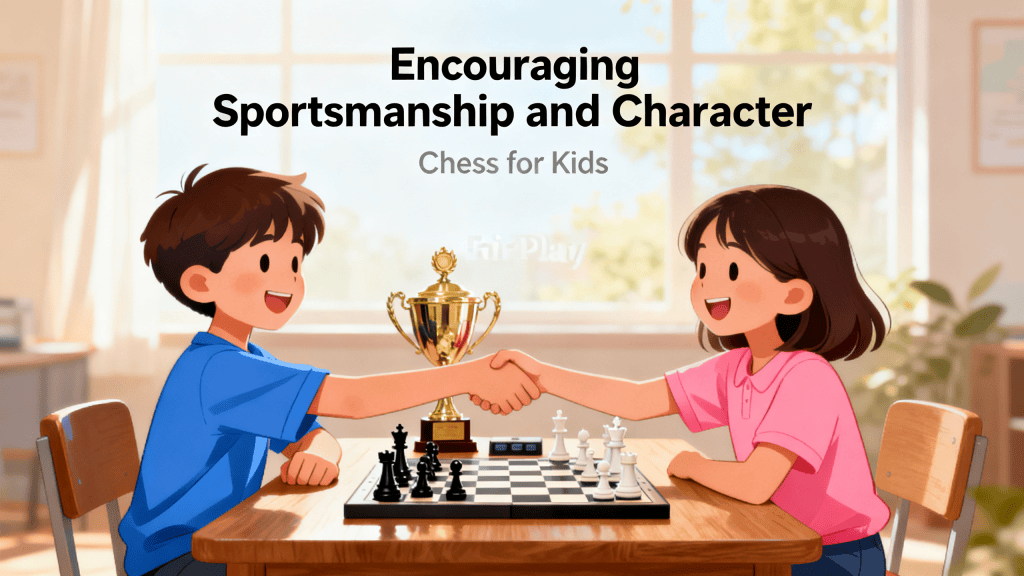
Chess is competitive, but it can teach children that competition does not require disrespect. Players generally begin and end games with a greeting or handshake, follow agreed rules, and recognize the effort of their opponent. These simple habits encourage courtesy and mutual respect.
Children learn to manage both victory and defeat. Winning can build confidence, but it also provides an opportunity to practice humility. A child can learn to celebrate without mocking an opponent, offer encouragement, and remember that one successful game does not guarantee future success. Losing, meanwhile, teaches children to accept responsibility without making excuses or blaming others.
Chess can also develop self-control. Players must wait for their turn, resist impulsive moves, and remain composed when the position becomes difficult. Creativity is another important part of the game. Although chess has fixed rules, the number of possible positions and plans is enormous. Children can experiment with different ideas, create combinations, and express their individual styles.
These experiences can support independence and self-confidence. A child who discovers a solution after careful thought receives evidence that difficult problems can be approached successfully. Confidence built in this way is more valuable than praise based only on winning, because it is connected to effort, reasoning, and persistence.
Supporting Friendships and Family Connections
Chess can be a strong social activity. School clubs, community programs, classes, and tournaments bring children together around a shared interest. Players learn by observing one another, discussing positions, solving puzzles, and analyzing games. These interactions can help children form friendships, including children who may not feel comfortable in more physically demanding or highly performative activities.
Chess also creates opportunities for communication. A coach may ask a child to explain why a move was chosen. A teammate may offer a different interpretation of the position. Through these conversations, children practice expressing ideas, listening to others, and disagreeing respectfully.
At home, chess can provide meaningful parent-child time. Unlike passive entertainment, a game requires both participants to remain engaged. Parents do not need to be expert players. They can learn alongside their children, solve beginner puzzles, or ask questions such as, “What are you thinking about?” The goal should be connection and shared learning rather than proving who is stronger.
An Accessible and Inclusive Activity
Chess does not depend primarily on speed, height, physical strength, or athletic ability. Children with different personalities and interests can participate. A quiet child may feel comfortable expressing creativity on the board, while a highly energetic child may benefit from the game’s structured pace.
The game can also be adapted to different ages and skill levels. Younger children may begin with simplified games or individual piece exercises. Older children may study strategy, play longer games, or participate in tournaments. Online and physical boards make chess available in many settings, although children should still be encouraged to balance screen-based chess with offline activities and healthy movement.
This accessibility does not mean every child will enjoy chess in the same way. Some children prefer casual games, while others enjoy serious competition. Respecting these differences is essential.
Practical Advice for Parents
Parents can help children benefit from chess by keeping the experience enjoyable. Begin with short games, simple puzzles, and clear explanations. Avoid overwhelming young players with excessive theory or long memorization assignments.
Praise thoughtful behavior rather than only victories. Comments such as “You considered your options carefully” or “You noticed the threat after reviewing the position” reinforce useful habits. After a loss, ask what the child learned instead of immediately criticizing the final mistake.
Competition can be motivating, but it should remain appropriate for the child’s age and temperament. Some children enjoy tournaments, while others prefer games with family or friends. Allow children to progress at their own pace, and make room for other activities, including physical exercise, reading, art, and unstructured play.
Conclusion
Chess benefits children because it combines enjoyment with meaningful mental and personal development. It encourages critical thinking, memory, concentration, planning, creativity, and responsible decision-making. It also gives children a practical way to experience mistakes, manage emotions, show respect, and recover from setbacks.
The game should not be treated as a guaranteed shortcut to higher grades or as an activity every child must pursue competitively. Its greatest value lies in the habits it can cultivate through regular, supportive play. Whether a child plays at home, in a classroom, or in a tournament, chess offers a rich environment for learning how to think carefully, act responsibly, persevere through difficulty, and connect positively with others.


