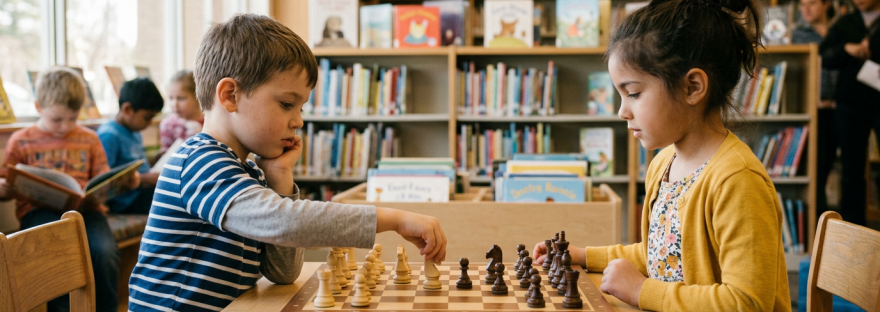
Two children playing chess at a library table
Uncategorized

How Chess Benefits Children

Chess is often described as a game of strategy, but for children it can be much more than a competition between two players. It is a playful way to develop thinking skills, emotional maturity, independence, and social confidence. Every game presents a new problem: a child must observe the position, consider several possibilities, predict consequences, and choose a response. At the same time, children learn to manage excitement, disappointment, pressure, and uncertainty.

The benefits of chess do not depend on becoming a tournament champion. A child can gain valuable experience simply by learning the rules, solving puzzles, playing casually with family members, or participating in a school chess club. When taught in an encouraging and age-appropriate way, chess provides a structured environment in which children can think deeply, make decisions, learn from mistakes, and enjoy meaningful interaction with others.

Developing Critical Thinking and Problem-Solving Skills
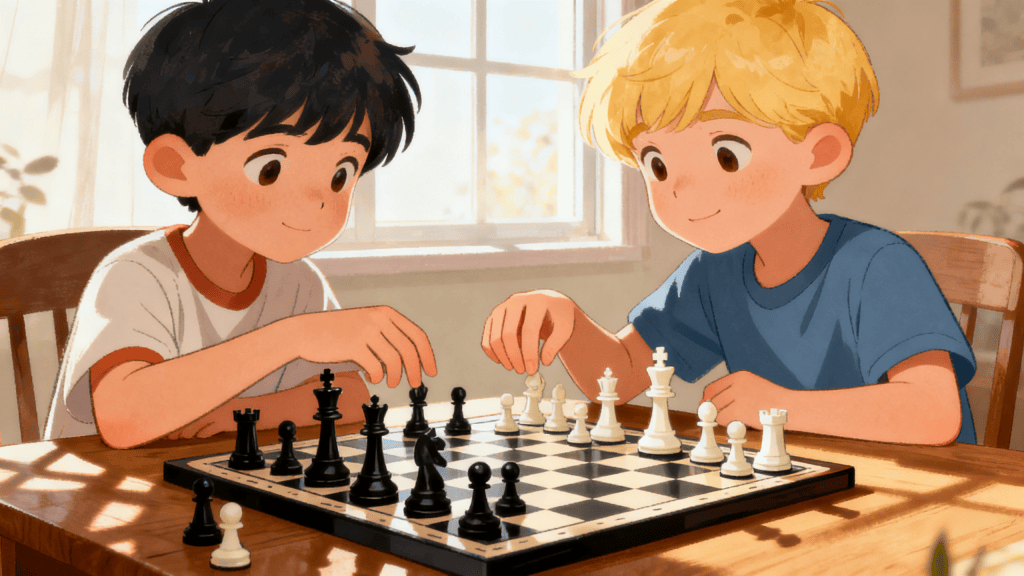
One of the clearest benefits of chess is that it encourages critical thinking. Children cannot play successfully by moving pieces randomly. Before making a move, they must examine the position, identify possible threats, and decide which option is most sensible.

For example, a child may notice that an opponent’s piece is attacking the queen. The child must then determine whether to move the queen, protect it, create a counterattack, or accept a different risk. This process involves analyzing information, comparing alternatives, and evaluating likely outcomes.

Chess also teaches children to adapt knowledge rather than merely repeat it. Beginners often learn familiar patterns, such as basic checkmates, opening principles, or tactical ideas. Memorizing these patterns is useful, but memorization alone is not enough. A position on the board may resemble a familiar example while containing important differences. Children must ask whether the same idea still works and, if not, how it should be modified.

This combination of memory and adaptation is a foundation of practical critical thinking. Children learn that knowledge is most useful when they understand how to apply it in changing circumstances. These habits can support problem-solving in other areas, including schoolwork, everyday decisions, and creative projects.

Strengthening Memory, Concentration, and Attention

Chess requires children to remember rules, piece movements, strategic principles, tactical patterns, and common positions. As they gain experience, they may also remember opening sequences, checkmate patterns, and mistakes from previous games. This repeated practice can strengthen their ability to recognize and organize information.

Concentration is equally important. A player must pay attention not only to personal plans but also to the opponent’s threats. A child who becomes distracted may overlook a simple capture or check. As a result, chess encourages children to maintain attention over an extended period and to return their focus to the position after each move.

Long games can also develop mental stamina. Children gradually learn that worthwhile results may require patience. They may need to examine several possibilities before finding a good move, or wait through a difficult position before an opportunity appears. This experience can help them understand that focused effort is sometimes gradual rather than immediately rewarding.

Chess should not be presented as a guaranteed solution for attention difficulties or as a substitute for professional support. However, its structure naturally gives children repeated opportunities to practice sustained attention, careful observation, and self-control. For some children, particularly those who enjoy strategy and puzzles, this makes concentration more engaging than exercises presented in isolation.

Learning to Plan and Make Decisions
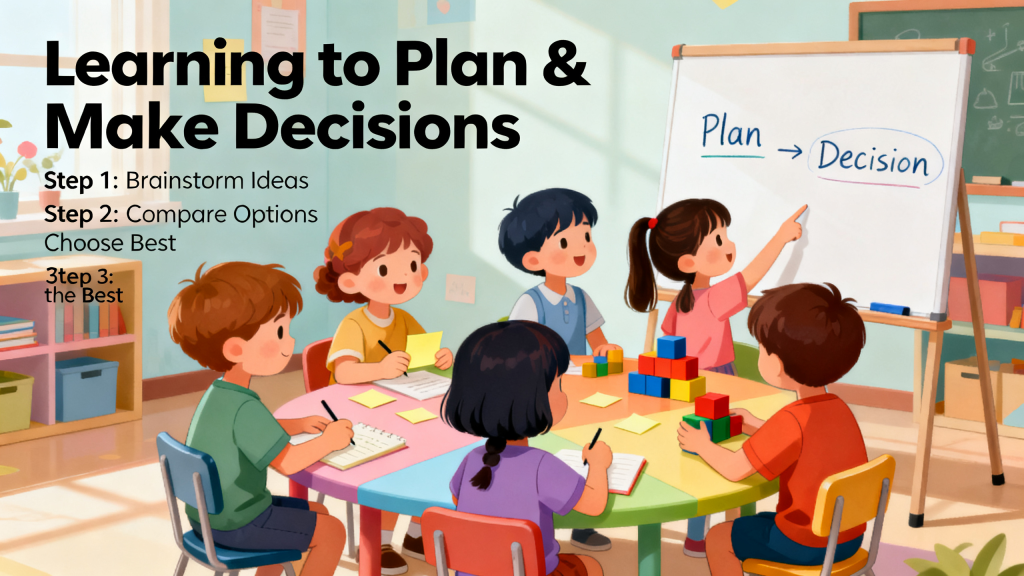
Every chess move is a decision with potential advantages and disadvantages. A child may have to choose between capturing material, developing a piece, defending the king, or preparing a longer-term plan. The strongest-looking move is not always the best one, and this teaches children to look beyond immediate rewards.

Chess also introduces the idea of thinking ahead. Players ask questions such as:

  • What does my opponent want to do?
  • What will happen after I make this move?
  • Which of my pieces may become vulnerable?
  • Is the potential reward worth the risk?
  • Do I have a plan if my first idea fails?

At first, young players may consider only one move at a time. With practice, they begin to calculate short sequences and anticipate possible responses. They also learn to distinguish between a plan and a guess. A plan is supported by observation and tested against the opponent’s likely reply.

Because chess is largely an individual activity, children experience a direct connection between decisions and outcomes. A careless move may lead to the loss of a piece, while a thoughtful decision may create an advantage. This does not mean children should be blamed harshly for mistakes. Rather, the game gives them a manageable setting in which to develop responsibility and learn that decisions have consequences.

Supporting Academic Development

Chess uses many skills that are also valuable in academic learning. Players interpret symbols, recognize patterns, compare alternatives, follow rules, and solve problems logically. The board also develops spatial reasoning: children must understand lines, distances, directions, relationships between pieces, and how a position may change after several moves.

These abilities are relevant to mathematics, particularly when children work with patterns, sequences, logical relationships, and planning. Chess can also support independent learning because children often review games, identify errors, study unfamiliar positions, and test possible solutions on their own.

Some studies have reported positive relationships between chess instruction and performance in areas such as mathematics and reading. However, these findings should be interpreted carefully. Chess does not automatically make every child achieve higher grades, and academic outcomes depend on many factors, including teaching quality, home environment, motivation, and the broader educational setting. Children who participate in chess may also differ from non-players in ways that influence achievement.

The most reasonable conclusion is that chess offers useful practice in transferable mental processes. When combined with good teaching and regular academic support, it may reinforce habits such as careful analysis, persistence, and independent problem-solving. It should complement, not replace, reading, mathematics, physical activity, creative work, and other important parts of childhood.

Building Emotional Resilience

Chess provides frequent opportunities to experience mistakes and setbacks. A child may overlook a threat, lose an important piece, or miss a chance to win. These moments can be frustrating, especially when the child has invested effort in the game. Yet this is also where chess can teach resilience.

After a game, children can examine what happened. Was the problem caused by moving too quickly? Did the child fail to notice an attack? Was the original plan unrealistic? By identifying a specific mistake, the child can turn disappointment into a practical lesson.

This process helps children understand that losing is not a permanent judgment about their intelligence or ability. It is information about what happened in one situation. Improvement comes from reviewing the experience and trying again.

Chess also teaches delayed gratification. A child may need to wait before launching an attack, develop pieces patiently, or preserve a small advantage over many moves. The game rewards attention and preparation rather than constant impulsive action. Over time, children can become more comfortable with slowing down, tolerating uncertainty, and working toward a result that is not immediate.

Adults play an important role in this process. If parents and teachers treat every game as a test of ability, chess may create unnecessary anxiety. If they treat mistakes as part of learning, children are more likely to develop confidence and persistence.

Encouraging Sportsmanship and Character
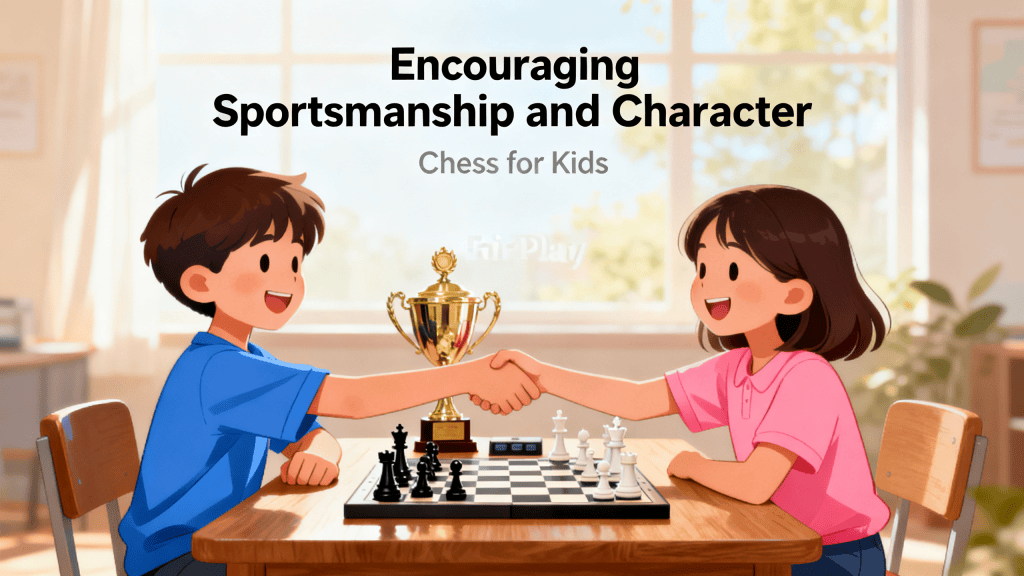
Chess is competitive, but it can teach children that competition does not require disrespect. Players generally begin and end games with a greeting or handshake, follow agreed rules, and recognize the effort of their opponent. These simple habits encourage courtesy and mutual respect.

Children learn to manage both victory and defeat. Winning can build confidence, but it also provides an opportunity to practice humility. A child can learn to celebrate without mocking an opponent, offer encouragement, and remember that one successful game does not guarantee future success. Losing, meanwhile, teaches children to accept responsibility without making excuses or blaming others.

Chess can also develop self-control. Players must wait for their turn, resist impulsive moves, and remain composed when the position becomes difficult. Creativity is another important part of the game. Although chess has fixed rules, the number of possible positions and plans is enormous. Children can experiment with different ideas, create combinations, and express their individual styles.

These experiences can support independence and self-confidence. A child who discovers a solution after careful thought receives evidence that difficult problems can be approached successfully. Confidence built in this way is more valuable than praise based only on winning, because it is connected to effort, reasoning, and persistence.

Supporting Friendships and Family Connections

Chess can be a strong social activity. School clubs, community programs, classes, and tournaments bring children together around a shared interest. Players learn by observing one another, discussing positions, solving puzzles, and analyzing games. These interactions can help children form friendships, including children who may not feel comfortable in more physically demanding or highly performative activities.

Chess also creates opportunities for communication. A coach may ask a child to explain why a move was chosen. A teammate may offer a different interpretation of the position. Through these conversations, children practice expressing ideas, listening to others, and disagreeing respectfully.

At home, chess can provide meaningful parent-child time. Unlike passive entertainment, a game requires both participants to remain engaged. Parents do not need to be expert players. They can learn alongside their children, solve beginner puzzles, or ask questions such as, “What are you thinking about?” The goal should be connection and shared learning rather than proving who is stronger.

An Accessible and Inclusive Activity

Chess does not depend primarily on speed, height, physical strength, or athletic ability. Children with different personalities and interests can participate. A quiet child may feel comfortable expressing creativity on the board, while a highly energetic child may benefit from the game’s structured pace.

The game can also be adapted to different ages and skill levels. Younger children may begin with simplified games or individual piece exercises. Older children may study strategy, play longer games, or participate in tournaments. Online and physical boards make chess available in many settings, although children should still be encouraged to balance screen-based chess with offline activities and healthy movement.

This accessibility does not mean every child will enjoy chess in the same way. Some children prefer casual games, while others enjoy serious competition. Respecting these differences is essential.

Practical Advice for Parents

Parents can help children benefit from chess by keeping the experience enjoyable. Begin with short games, simple puzzles, and clear explanations. Avoid overwhelming young players with excessive theory or long memorization assignments.

Praise thoughtful behavior rather than only victories. Comments such as “You considered your options carefully” or “You noticed the threat after reviewing the position” reinforce useful habits. After a loss, ask what the child learned instead of immediately criticizing the final mistake.

Competition can be motivating, but it should remain appropriate for the child’s age and temperament. Some children enjoy tournaments, while others prefer games with family or friends. Allow children to progress at their own pace, and make room for other activities, including physical exercise, reading, art, and unstructured play.

Conclusion

Chess benefits children because it combines enjoyment with meaningful mental and personal development. It encourages critical thinking, memory, concentration, planning, creativity, and responsible decision-making. It also gives children a practical way to experience mistakes, manage emotions, show respect, and recover from setbacks.

The game should not be treated as a guaranteed shortcut to higher grades or as an activity every child must pursue competitively. Its greatest value lies in the habits it can cultivate through regular, supportive play. Whether a child plays at home, in a classroom, or in a tournament, chess offers a rich environment for learning how to think carefully, act responsibly, persevere through difficulty, and connect positively with others.

Uncategorized

We are not the same

I believe all life is sacred, especially those of the innocent babies

You believe that babies are a burden that should be murdered before they are even born.

I believe that everyone should learn to love themselves, and work hard to become the best versions of themselves.

You believe everyone should either chop up or drug themselves up in order to “feel better”.

I believe that life is an amazing gift that we should all treasure for as long as we can.

You believe life is a burden that has no meaning and should be allowed to be ended whenever we feel like it.

I believe that parents should be responsible for their children’s education and forming their values.

You believe that the government should be in control of all spread of information.

I believe that race is irrelevant.

You believe that everyone should be judged primarily by their race as some are better and/or more capable than others.

I believe that if you want something in life that you need to work for it, contribute to society, and earn it.

You believe that everyone else should do the work for you so that you can get everything for free.

I believe in open dialog and sharing ideas.

You believe in silencing anyone who dares disagree with you.

I believe that violent criminals should be locked away forever, if not killed of the crime is severe enough.

You believe the criminal is the victim and should be released and given compensated for his troubles.

I believe everyone has the right to be as rich as they are capable of being.

You believe that everyone who is rich is evil… unless it’s you.

I believe that you should fall in love, commit to one person, and have a family.

You believe in hook up culture, sex workers, porn, and spending your days high with no responsibilities.

I believe that The United States is the best country in the world who fought to protect others numerous time and has, for the most part created more than destroyed in comparison to any other nation.

You believe in destroying it all.

My martyr was a family man who was murdered while having a civil conversation.

Your martyr died of a drug overdose while resisting arrest.

When My martyr falls I pray in the streets.

When your martyr falls you burn them down

I believe that murdering someone for their opinion is evil.

You believe it is funny.

We are not the same.

Uncategorized

It’s been a week since Charlie Kirk

It has been a week since Charlie Kirk was brutally taken from the world, and no one can stop talking about him. Both sides of the isle have been whipped up into a frenzy over his death. One side claiming that he deserved to be murdered because he was evil and spread hate, and the other side deeply grieving a man whose only crime was disagreeing with those he spoke with.

I have been watching Charlie Kirk for years. I have become obsessed with news over the last few years, as many have, and find myself going down the rabbit whole of debates and commentary. He was my go to when I wanted something lighthearted and civil. He was the one that I went to when I wanted to watch what the youth of today was being taught to think and how one could politely disagree and possibly change some minds.

That was the problem. Charlie could change minds. Charlie could have a respectful conversation with those he disagreed with and they could start to understand his point. They could see him as a person who just had different information or different opinions about a subject and that is ok.

He also helped conservative students find their voices. As someone who has recently gone back to school as an adult for my MEd I can’t believe the indoctrination process. I was told that I had mandatory Critical Theory classes and when I disagreed with the teacher she didn’t listen to my argument and evaluate if I had made valid points, but just disagreed with the methods. No, I was told to comply or fail. I took the F and switched schools.

This was me as a middle aged mother who has decades of bullies behind me and an understanding that you can never comply or they will not stop. Imagine being the 18 year old kids leaving their homes for the first time and being told if they disagree with their professors that their futures will be ruined. Charlie gave them other options. Up to and including the understanding that state sanctioned school is almost never the answer.

Will the loss of Charlie Kirk I feel for his family and especially his kids. He was such an ambassador for the importance of having a father in the house, and now his poor babies will grow up without him. I understand that loss. My son lost his father when he was only 6. The difference is that Charlie Kirk left behind hours of footage that his babies can watch and learn from. Charlie Kirk touched the hearts of millions of people who are forever changed. Charlie Kirk has been gone from this world for a week, but his legacy will never be lost. We are all Charlie Kirk now, and those who don’t like it can sit down and watch us rise.

Uncategorized

School Choice Could Revolutionize Homeschool

I love memes. I scroll them and laugh at them. I share them and discuss them. I think they are a very important part of today’s society. Meme’s are the current day jesters poking fun at society around us and sometimes informing us of things we didn’t know.

A bit ago I came across an interesting meme about the cost of education in the US. Everyone always complains about how horrible the public school system is, how little teachers are paid, and how over crowded the classrooms are. They are a few of the criticisms that lead to so many people wanting school choice in their area. They want the ability to send their children to whichever school they choose regardless of whether or not they live in the district.

I understand why certain people are opposed to this. It’s not because they are afraid that standards would drop. As it is more than half the population can’t read above a 6th grade level and many of the urban areas have poor graduation rates and even worse literacy rates. In fact the US is ranked 125th in the world on literacy. So if it isn’t keeping standards up, what else could be the reason why some don’t want parents deciding where, and how to educate their children? I think the bigger question is what are the schools educating the children on if not how to read, write and do math.

I can tell you that they are not teaching basic life skills. Even those in good schools with high graduation and literacy rates complain they aren’t being taught the basics of personal finance, how to make and stay on a budget, or how to do their own taxes, or even what taxes are used for. Civics itself has gone straight out the window in order to teach opinions of the day.

The meme in question that I came across (pictured to the left) had another idea. Instead of paying for administrators and union dues, and DEI programs, how about we give them money to the parents to decide who they want to teach their children? Homeschooling would be transformed by this. Pods is a form of homeschooling in which a parent who knows a little something about a subject creates/or buys a curriculum and teaches a group of children who sign up for the pod. There are also online programs and curriculum on sale everywhere to help just the regular parents who wants to teach their children themselves.

Imagine if parents were given the $15,424 per child to be able to stay home and teach their children the kinds of things they wanted taught. The kinds of things that would be necessary for the child’s actual future. Imagine if they could find a few teachers in the area with their own expertise and work out a schedule with other pods and create a whole network of homeschoolers with access to different teachers, different subjects, and different ideas not offered in the current system. Imagine being a mother of 3 who now gets to stay home and be the person who helps her children grow into the amazing people they are going to be without worrying about the violence, the bullying and the indoctrination that happens in the local school system. Imagine being an inner city mom who gets a check for $46,272 to be able to stay home with your kids and not send them through the metal detectors of an institution that isn’t even going to teach them to read.

Every day I hear parents wishing they could stay home with their kids, but they just can’t afford it. Well, to quote Good Will Hunting “You wasted $150,000 on an education you coulda got for $1.50 in late fees at the public library.” Imagine being a mom who could take your kids on field trips everyday, and read to them snuggled on the couch instead of heading out into the cold to drop them off to a building you don’t know, with people you don’t know to learn about things that you don’t know. Imagine having your kids be yours instead of the institutions.

Politics

Saving Democracy… by Destroying it

Everyday I see headlines about how the Republican party is trying to destroy democracy and that the only way to save it is by voting for which ever Democrat is running. The problem with this concept is that the Democratic candidates are being chosen democratically.

Back in 2016 I remember voting in the primary and everyone I knew was up in arms because Bernie Sanders kept winning the popular vote but somehow “super delegates” were changing the way democracy was handled and were putting into place Hillary Clinton. In 2020 Bernie was back to making trouble for the Democrats taking way too many of the regular delegates for comfort so again the super delegates stepped in to save the day.

The Republican have their own set of super delegates but they are pledged to vote the way the people have voted. They are not entitled to change the direction of the party on their whim. They follow a little thing called democracy and letting the people decide.

Now I know lots of people are going to say that we are a democratic republic and not a straight democracy, and I understand that. That is the reasons for the delegates in the first place. It’s not a straight popular vote. The votes are based more on the area themselves choosing a candidate than the individual people but if, for instance there are 2 candidates and neither has enough votes to be considered the all out winner of an area, and the super delegates come and and just throw all of their support behind which ever candidate they choose then the people and the states have not chosen. What should happen is a runoff election in which the two main candidates run against each other without 3rd party options. Then maybe someone would have enough votes, and if not then the super delegates get behind which candidate the state voted for, not having super delegates choose their own candidates for their own reasons.

So in both 2016 and 2020 the Democratic party used super delegates to choose who the party wanted instead of listening to the voters. Flash forward to 2024 and now the Democratic party basically held a closed primary saying that they are running the incumbent and not willing to put any money behind any other candidate. They quickly moved to keep RFK jr. out of the running and secured all the delegates to vote for their man that was already in office….

EXCEPT now their man is not the one on the ticket. They have manipulated the system again and put a woman that was unable to win her own state or obtain 1 delegate in the last primary straight into the official candidate running. No one voted for her… I mean ever. No one agree to this. The people had zero say in who their candidate was. All the people who donated for “Uncle Joe” are now having their donations transferred over to the woman who manipulated the system. (And I don’t just mean the justice system to keep innocent people in prison for slave labor like she did in California). The Democrats usurped the democratic system and installed their own person again.

How is any of this democracy?

cancel culture, Mental Health, Politics, school shootings, Uncategorized

The Impact of Hateful Rhetoric in Political Discourse

In case you missed it. The ex President and current front runner to be the next President of the United States just had his life almost taken by an attempted assassin. This is not the 1st time, and it probably won’t be the last when someone crazy decides to listen to the hateful rhetoric by their party and the legacy media to cast an opponent as evil and worthy of death. Obviously the only person criminally responsible for the attempted assassination was the trigger man himself, but he is not the only one responsible morally.

There was a time in political debate when people argued the issues. When people discussed why taxes should be higher or lower, whether Medicare/Medicaid/ social security was a drain or wasn’t enough, whether we should put more money into schools or infostructure. Now people are arguing about who is more of a dictator and who wants to destroy the whole country, and who is just plain evil.

When you spend all day every day calling your opponent “Hitler” it shouldn’t be a surprise that someone wants to kill him. Everyone wants to kill Hitler. If given the chance I’m sure it would be on almost every bucket list, so calling your opponent Hitler every day for a decade… what could you possibly have expected?

I understand trash talk. I understand inflammatory speech like, “Let’s get out there and kick some a**!” or “We’re going to fight like He77!”. What I don’t understand is how anyone can go around spreading lies about the competition, and brainwashing an entire community because you don’t want to “fight” on the issues.

If they actually believed he was the next Hitler then they would be praising the shooter. A lot of people are. A lot of people do believe the rhetoric and honestly believe that their “enemy” should be eliminated, but those in charge know they are lying. They know he’s just a guy that wants different policies and procedures than they do. But they are sill responsible for their words and actions. We all are.

Motivation, parenting, Politics, Uncategorized

How is it Progressive to Destroy Everything?

All I hear from progressives every single day is about how bad everything is. They say the police are bad and need to be defunded, yet call them on everyone all the time. They say the government is bad, and racist, but they want to give the feds more and more power. They say that every institution in the country is racist and sexist, that personal isms has lessened, but institutional isms are still strong, but can’t point to one policy which supports this, it’s all about the people who are instituting the policies.. even though personal isms are down.

They want to end wars by supporting terrorist. They want to fight fascism by taking away individual rights. They want to celebrate diversity, by stopping people from disagreeing with them. They want to sexualize children and murder babies before they’re born.. all in the name of rights for people who aren’t capable of picking out what they want for breakfast… or, you know… haven’t taken their first breath yet.

These people think that immediate self gratification is more important than human rights. They think the rights of women to have indiscriminate sex with no repercussions are more important than the rights of people who are conceived by this random hook-up culture. They think people should be allowed to rob local stores for whatever they could possibly need, because it’s their human right to have stuff, but it’s not the store owner’s human right to protect their own property.

These people want to destroy everything that we’ve all worked so hard to build up, because they think it’s unfair that people have to work for things. They think it’s unfair that those who have accomplished things in the past have the right to help their family in the present. They are mad that they’re bad choices have consequences and blame people 100 years ago fort their failures today. They want to destroy everything that they see, because today’s progressives are like toddlers who don’t like that their friends built a higher tower than they did and rather than asking for help or trying harder they just knock down their friend’s . They’d rather everyone be miserable than have to put in the effort to try to be better.

Uncategorized

Culture is Creating a Bigger Generational Gap

I remember seeing someone that I watch on my podcast talk about how culture is dying. He commented that there is nothing new coming out, and everything is just a rehash of everything old. I found that interesting, and wondered what that all meant.

I had noticed that all of the magazines and movies still had actors and actresses in them that I grew up with. In the last 10 years the People’s Sexiest Man Alive have been from my generation or at least older Millennials.: Patrick Dempsey, Chris Evans, Paul Rudd, John Legend, Idris Alba, Blake Sheldon, Dwayne Johnson, David Beckham, Chris Hemsworth, and Adam Levine.

When we talk about the top grossing movies and who stars in them most of them are Marvel movies that are predominately Gen-X and older millennial stars, There’s some Harry Potter movies based on books that came out when Millennials were kids, and then a lot of remakes like The Fast and the Furious, Despicable me, and Jurassic Park… again. The best movies are still the cult classics like the John Hughes films and pop culture has created merch around my childhood.

I recently started to listen to the radio again and I noticed in my area, which is the Boston area, not some hick county, there are now 3 stations with K-Love (a Christian radio station), and most of the others play hits of the 70s, 80s, and 90s. That’s 50 years ago! I remember when they got rid of the “Oldies” station because it’s original intent was to play music for the Boomers from when they were kids and at the time it was 20-30 years old.

The average age of the best actor that one the Oscar this year was 53. The average age for a woman was 45 . It is hardly a young person’s game anymore. Growing up most of the big actor were in their 30s. Names like Brad Pitt, Johnny Depp, Keanu Reeves, Tom Hanks.. they were the young people when I was growing up, and they are still the ones on the cover of all the magazines and TMZ follows around like puppies.

I was starting to think that the guy in the podcast was right. Until I went to the movies with my kid. When I was younger going to the movies was what everyone did. Every Friday and Saturday night the place was packed. We always walked to the theater which was best because there was never any parking. Even when my goddaughters were young and I’d take them to the movies there was always a line for popcorn and the bathroom. One of them is a young Millennial the other a Gen-z.

Now when you go to the theater it’s empty. Now everyone stays home and streams movies. They stream movies and videos and shorts on their own devices. When I was little everyone watched the one TV in the house with their whole family. Now I have to check my kid’s YouTube history to see what he’s watching. Though he and I do have our shows that we watch together on the apps. I’m looking at you Father Brown.

Kids today don’t listen to the radio in the cars with their parent. They are plugged into whatever device they have through Bluetooth headphones and have no idea what’s going on around them. And the adults have no idea what the kids are watching. There is no shared culture because no one shares anything. Everyone is in their own bubble. The new generation doesn’t have a favorite actor. They have their favorite influencer or gamer. My kid is all about Unspeakable and .. I wanna say Ubb.. but part of me feels like that can’t be real.

If we want to have a future and a community and culture that we all share. We have to start unplugging and start communicating again.

Addiction, coaching, free speech, Motivation, parenting, Uncategorized, women

Why do people hate life?

I suppose a good place to start is to ask what is life? If you Google this question the first response is a dictionary entry

life

/līf/

noun

1.the condition that distinguishes animals and plants from inorganic matter, including the capacity for growth, reproduction, functional activity, and continual change preceding death.”the origins of life”Similar:existencebeinglivinganimationalivenessanimatenessentitysentiencecreationsurvivalviabilityesseOpposite:deathnonexistence

2.the existence of an individual human being or animal.”a disaster that claimed the lives of 266 Americans”

I don’t really think that helps. I mean, I guess it helps to understand when life begins and ends, which people seem to have forgotten somehow.

When you ask people today about life you tend to get responses like, “Life sucks, then you die”. They actually put that on pins and bumper stickers. People commiserate with each other about how awful life is. They talk about how we spend our whole life working just to die. This is the general consensus.

The amount of Gen Z and Millennials who never want to have children is staggering, and they mostly blame the economy or climate change for this problem. Which is ridiculous when you think about the fact that people have been having children since people have been around and we are richer as a society than we have ever been.

People are putting gadgets and comforts before actual lives. And I don’t mean that metaphorically. Women are actually killing their children and most of the time it is over financial reasons. It may interfere with their career plans, or kids are just too expensive to begin with. In 2023 there were 1,026,700 babies murdered before they were even born. That doesn’t seem “safe, legal and RARE” as everyone used to claim they would be. This is a genocide People are purposefully killing unborn people for their own desires. Women are being taught that having a baby is not even one of the choices they can make.

Celebrities like Chelsea Handler make mock videos like, A Day in the Life of a Childless Woman in which they talk about doing the most useless and ridiculous things just to glorify this path. People are told that being able to travel is impossible once you have kids, but then people complain that they can’t travel anyway because they always have to work to support their lifestyle.

Now this lifestyle that they speak of isn’t the same as Chelsea Handler’s running off to Paris for the afternoon. No, it’s $10 coffee drinks, and $300 bar tabs, and takeout every night because cooking is part of the patriarchy. It’s the latest iPhone, and the latest shoe of choice (whether it be a Jimmy Choo or a pair of Nike with a celebrity name on it all of which cost more than my rent in the 90s). And none of this counts as being excessive it’s just “self care” . Which we can’t forget hair and nails done every week.. that’s what life is all about now.

People are being taught that human rights are not actually rights and that humans are the problem. They are being taught that free speech and meritocracy are the problem and that the only thing that is important is buying more things and not working, because working is the patriarchy. Which is ironic since it used to be that men did most of the work and women just lived life taking care of their kids and the home.. but that was bad too. Everything is bad.

If you have a bad feeling take a drug. If you have a good feeling take a drug. If you’re not feeling enough take a drug. If you’re feeling too much take a drug. But whatever you do. Do not go outside and get fresh air. Do not exercise. That is the patriarchy telling you how you should look and feel. Here.. have a pill instead and zone out on the couch watching other people live. Because life itself is the problem.

parenting, Uncategorized, women, Women's movement

How much to you pay other people to take care of your family?

Everyone says that they can’t afford to not have a 2 income family. They talk about how expensive kids are and how much it costs to run a household, yet they forget that a lot of the expenses that they speak of are only necessary because they have a two income family.

There are literal memes out there complaining about how their parents bought homes, and cars, and paid for college all on one income back in the 50s…. meanwhile. I’m almost 50 and my dad was in grade school in the 50s so I don’t know how old these Gen-Zers think their parents are. They are going back at least 4 generations to talk about the times of the 50s.

On top of that they complain about the families of the 50s and how they would never want to live the “trad” life. A woman shouldn’t be forced to stay home and take care of their family all the time. They should be free to work everyday of their life and complain about how they would much rather be home but they can’t “afford to live” without that 2nd paycheck.

Some part of this is true. You can’t always keep up the same lifestyle that you want to live with only one income. For instance this was the average house bought in the 50s. There was no dishwasher, no washing machines or dryer, no microwave. no a/c, no trash compactor, or probably garbage disposal… and that’s not even getting into the fact that there was one phone that was plugged into the wall. Complete plumbing (hot and cold piped water, a bath-tub or shower, and a flush toilet) was only available in 64.5% of homes in 1950. There probably wasn’t a TV and there was one radio that the whole house shared. I mean, sure, it was affordable back then. There was a lot less to buy.

Now people want a new $1000 phone every 2 years. A new car every 4 years. That doesn’t include computers, tablets, gaming systems. shoes that cost more than most cars did back in the 50s, and if you do buy a house and something breaks. No one learns how to repair things on their own. They just call someone to deliver a brand new one. Shopping is the worlds pastime.

A new house today comes with all of the amenities. There are refrigerators, and ovens that can talk to your phone so that you can know when there is a problem and it’s ready to buy a new one. There are sound systems set up all over the house that can connect to which ever electronic you Bluetooth with to make a movie or song play through out the whole house and outside… but that’s not an extra. That’s just normal today. When I was a kid a house didn’t even come with a fridge.

And that’s just the house. Now lets talk about daycare. You can’t afford kids or for both parents to not work because daycare is on average $18,886/ per year. Then if you add more than one kid you’re talking almost the average salary for a person in the US per year; $47,424. Then when you start to add some of the other things like take out for a household is about $3600/ year (a household can also include 1 person living alone so the average for a family of 4 will be substantially higher). All of this doesn’t count things like grabbing coffee, or other snacking items along the way. In the 50s families rarely ate out together. Moms just cooked.

Then there are the other extras that not everyone partakes in like having someone come in and clean the house once a month or so. That’s about $2400/year. Then you can add in things like pet walkers and groomers. When you start adding in things like every TV/Movie app, and personal trainers/gym membership, then yeah life can be quite expensive, but it doesn’t have to be.

How much are you paying other people to do things for you. Things that you could do yourself if you weren’t working. Things you would probably enjoy doing if you weren’t working. Everyone complains that they don’t have enough money, and everyone complains that they hate working. Hell, everyone complains about he capitalistic society that we all live in… yet, we work a 2 income family to not spend time with our family so that we can pay other people to take care of them, so that we can buy things we don’t need, and complain that people before us had it better… because they didn’t priorities the latest iPhone.